Great Lakes: Radionuclides are persistent, toxic
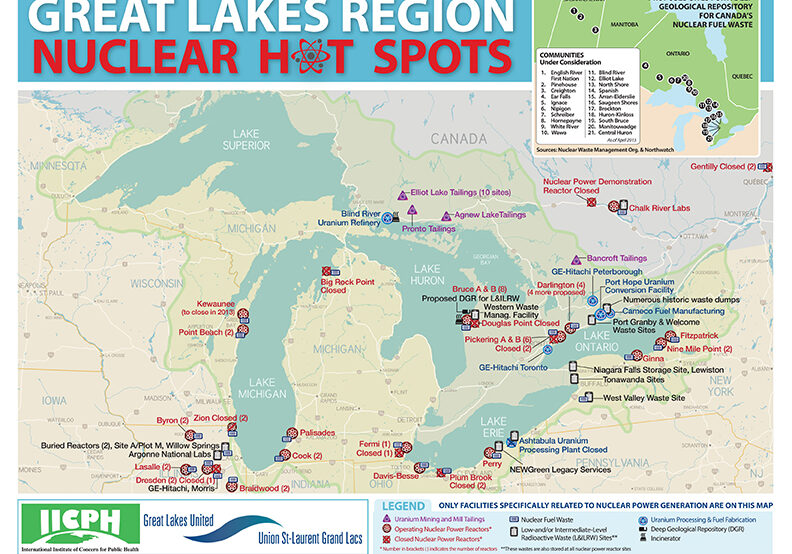
In 2016 and again in 2022, more than 100 advocacy groups nominated radionuclides for designation as Chemicals of Mutual Concern (CMCs) under the 2012 Great Lakes Water Quality Agreement (GLWQA). The GLWQA is a joint agreement between the U.S. and Canada, which border the Great Lakes. It has the overall goal of ridding the Great Lakes of persistent toxic substances. However, in June 2025, Canadian and U.S. co-leads recommended against advancing radionuclides past the initial screening stage, effectively halting further consideration. Signatories and groups, provided summary and supplemental reports (links below) challenging this decision, arguing it disregards both GLWQA principles and significant evidence of risks.
Framework and Principles
CMC designations are guided by GLWQA commitments, including the ecosystem approach, precaution, prevention, sustainability, and public engagement. These forward-looking principles are especially critical for radionuclides, which can cause long-term, intergenerational harm. There is no safe threshold for radiation exposure, and Great Lakes’ long retention times amplify risks. Some radionuclides remain hazardous for hundreds of thousands of years, underscoring the need for proactive, precautionary management.
Health Research Gaps
One supporting report identifies major deficiencies in government assessments of radionuclide impacts. Regulatory frameworks inadequately account for:
– Internal exposures, such as ingestion or inhalation of radioactive particles.
– Vulnerable populations, particularly women, children, and pregnancy.
– Non-cancer outcomes, including cardiovascular, neurological, and respiratory diseases.
Despite documented health problems in Port Hope, Ontario, and evidence of increased disease near nuclear facilities, both Canadian and U.S. agencies have discontinued relevant health studies. Canada declined further investigations after finding elevated disease rates, while the U.S. NRC cancelled a National Academy of Sciences study on childhood cancer near nuclear plants. Meanwhile, both countries are accelerating nuclear expansion near the Great Lakes. This supplemental report concludes that without CMC designation, agencies will continue ignoring significant data gaps, leaving public health unprotected.
Flaws in Regulatory Oversight
Governments concluded that existing regulations adequately manage radionuclides. A second supplemental report focused on Canadian agencies disputes this, citing evidence of regulatory capture: agencies are entangled with industry promotion, regulators fail to act independently, and civil society concerns are marginalized. The lack of separation between industry promotion and oversight has historically led to catastrophic outcomes. Similarly, a third report points to recent U.S. executive orders weakening NRC authority, fast-tracking new reactors, curtailing public participation, and lowering safety standards. These shifts highlight growing risks, not reasons to avoid CMC designation.
Unexpected and Catastrophic Events
Government assessments focus narrowly on routine releases, ignoring the potential for accidents. In additional reports, experts emphasize that while accidents may be low probability, consequences for health, ecosystems, and economies would be immense. Given the presence of nearly every stage of the nuclear fuel cycle in the basin, from mining to waste storage, catastrophic events cannot be discounted. Planned waste shipments in Ontario—spanning decades, thousands of kilometers, and poorly maintained routes—further amplify risks. The precautionary principle embedded in GLWQA demands that these scenarios be considered.
Transboundary Concerns
Governments downplayed cross-border risks, asserting no evidence of lakewide or multi-lake contamination. Yet numerous nuclear facilities discharge directly into the Great Lakes or their tributaries, and long retention times mean radionuclides can accumulate in sediments, water, and biota. Airborne releases and spills during transport also have clear transboundary potential. The governments’ conclusion of “no binational significance” disregards the interconnectedness of Great Lakes waters and the persistence of radionuclides.
Summary and Recommendations
In the summary and supporting documents, the experts and citizens argue that governments’ initial screenings fail to respect GLWQA principles, rely on unwarranted confidence in regulatory sufficiency, and dismiss both current evidence and future risks. Only eight substances have been designated as CMCs since 2012, raising questions about whether the process meaningfully protects the public. Suppressing public concern undermines transparency and accountability.
The authors recommend advancing radionuclides to the next stage: a detailed screening and Binational Summary Report, followed by formal public consultation before a final decision. Such a process would address knowledge gaps, incorporate precautionary measures, and ensure public participation in decisions affecting the health of the 36 million residents who depend on the Great Lakes.
Support Beyond Nuclear
Help to ensure a safer, greener and more just world for all