Radiant booted from WY Heads to TN
On October 13, 2025, the El Segundo, California-based nuclear startup company, Radiant Industries, abruptly announced a change of project plans from what had quickly became unpopular to build the nation’s first mass production assembly line in Wyoming for its new micro-nuclear power generator (~1 megawatt electric high temperature gas cooled reactor) plant design. Radiant launched its trial run with a public meeting on March 25, 2025 and was greeted by a questioning public in the Rocky Mountain’s High Plains small town of Bar Nunn, Wyoming (pop. ~3,000). When the assembled public didn’t get the straight answers they were expecting, the follow-up meetings turned contentious. Start to finish, 202 days later, Radiant publicly announced in a Letter to the Editor in the Cowboy State Daily that the company was moving its atomic assembly line for the Kaleidos reactor (Greek for “beautiful kind”) to the Department of Energy’s Oak Ridge National Laboratory in Oak Ridge, Tennessee, one of the nation’s original “Manhattan Project” atomic bomb production facilities.
As Samantha Fowler, a vocal self-styled Natrona County community activist describes it,
“When Radiant Industries came to Wyoming, they talked like pioneers. From the beginning, residents started asking about safety, radioactive waste, and who would be responsible if something went wrong. Instead of answers, we got rehearsed lines. The Bar Nunn Town Council and mayor told us the waste would be ‘temporary’ and ‘safely managed,’ but never explained where it would go or how long ‘temporary’ really meant. They refused to let the community vote on it, ignored petitions, and acted like concerned citizens were an obstacle instead of the people they were supposed to represent. That is when Radiant went silent. Matt Wilson, who had been the face of the project in Wyoming, suddenly scrubbed Radiant’s presence from public view. No updates, no statements, nothing. And when the news finally came that Radiant was leaving for Tennessee, Wilson didn’t acknowledge the public pressure or the fact that Bar Nunn had stood its ground. Instead, he insulted the people who had done their homework. He said Wyoming had a ‘poor nuclear IQ.’ That was his parting shot.”
The public’s questions, like corporate accountability, are completely justified.
After all, Radiant’s claim that its design is completely “failsafe” from a potential severe nuclear accident is not actually backed up by the facts. The company’s financial liability for the full cost of potential radiation health consequences and long term environmental contamination is actually protected by Congress’ extension of the Price-Anderson Limited Liability Act from 2025 to 2065 which assigns federal limited liability coverage from the nuclear industry’s accountability in the event of a meltdown. Reliance on the US taxpayer is not a show of industry confidence in its own claim of “inherent safety.”
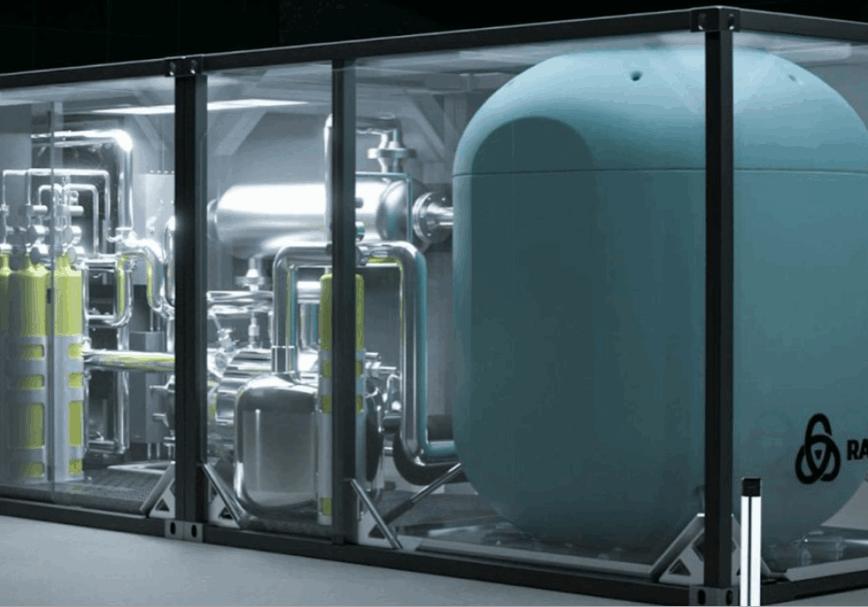
Radiant claims that this unprecedented mass assembly line will be able to roll out 50 microreactor units each year. These are intended to be fully factory assembled reactor units, each the size of a single shipping container. They are being advertised as transportable to anywhere, potentially even onto the battlefield. According to a US Army press announcement, the US military has launched its “Janus” project to essentially replace the military’s use of conventional diesel generators with deployable microreactors mounted on the back of flatbed trucks and stationary at military bases, including the Radiant’s Kaleidos unit and Oklo’s Aurora sodium cooled fast reactor (projected unit design ranges from 1.5 MWe to 75 MWe), if the designs can be mass produced to such scale.
Radiant is also promoting the project will produce its first pilot plant model for US Department of Energy testing in 2026. However, anybody familiar with the eight decades of history of the atomic power industry is aware of their gross failure to meet estimates for time-to-completion and cost-of-completion. Radiant hasn’t yet completed the actual reactor design for approval and testing or submitted an application to the US Nuclear Reactor Commission for the reactor construction permit and the operating license. Radiant is still in the NRC pre-application process which is developing the design largely behind closed doors as proprietary trade secrets/
Radiant is betting on an assembled a core group with advanced engineering experience (some formerly with SpaceX and Oak Ridge National Laboratory) and their claim that they can start their initial reactor deployments to customers beginning in 2028.
Radiant’s Kaleidos microreactor project is not only designed to be entirely factory built and mass produced, it is planned to be factory loaded with high-assay low enriched uranium (HALEU) fuel so that it can be domestically shipped and globally exported directly from the factory to the purchaser for “plug and power” as if it really were a standard electrical generator ready for a five-year operational cycle. The HALEU fuel (less than 20% enriched U-235 also scientifically recognized as “bomb prone fuel’) is presently commercially available globally only from Russia. The Radiant design also requires after 5 years of operation the entire unit is shipped back to the factory site for refueling That means that each of these reactor vessels will travelling on interstate highways, public roads, rails and barges full of high-level radioactive waste (irradiated nuclear fuel). Upon return to the factory, the highly radioactive used fuel core is removed for indefinite onsite storage and the reactor is reloaded with new HALEU fuel before returning to the purchaser. The hauling of the entire fuel loaded reactor unit for refueling and return for nuclear waste dumping at the factory is central to Radiant’s new nuclear business model of mass-produced, portable nuclear-powered generators.
However, given there isn’t a scientifically demonstrated and publicly accepted long term nuclear waste management and isolation, Radiant’s vague and indefinite plan being hauled back across the country and from around the world is not convincing of all points in between. The Bar Nunn residents were quick to make it their principle objection as well as many of their political representatives. That was enough resistance that Radiant quickly decided that their atomic project “must build where the rules are clear, the government is predictable, and businesses are free to invest and grow” with the acceptance of a mountain of nuclear waste as need be.
So the new plan is for Radiant to build its nuclear power plant factory on land at Oak Ridge, Tennessee that has already been a “national sacrifice zone” for the past 83 years. The new host area is part of the 56,000 acres of the Oak Ridge originally appropriated by federal “eminent domain” on September 29, 1942 by Corps of Engineers. It is not often included in the Manhattan Projects’ officially history, but many poor rural communities were seized and those families permanently forced out with little to no compensation to make way for one of the major “Manhattan Project” sites. The Manhattan Project also included large seizures of indigenous lands and forced relocations from Los Alamos and Alamogordo, New Mexico and Hanford, Washington for the development, production, testing and eventual use of the first atomic bombs in that time of world war.
Radiant is currently preparing to start site work at these previously contaminated sites at the now decommissioned after decades of cleanup at the K-27 and K-29 gaseous diffusion uranium enrichment facilities. There is still ongoing environmental cleanup and site remediation today including extensive groundwater contamination cleanup. According to the American Nuclear Society, the decommissioned K-27 site is described as ready for industrial development. The K-29 site is part of the Oak Ridge Environmental Development Program’s East Tennessee Technology Park (ETTP) with ongoing site remediation and cleanup. Radiant projects it will begin factory site preparation and construction in early 2026.
As regards the status of the Kaleidos micro-reactor design itself, the primary federal agencies engaged in the still ongoing development and licensing approval of the project are the US Department of Energy (DOE), the US Department of Defense (DOD) and the US Nuclear Regulatory Commission (NRC).
The DOE is involved in the project’s research, development, and testing programs through the National Reactor Innovation Center (NRIC) and the Demonstration Of Microreactor Experiments (DOME) facility.
Per the DOD and the Department of the Army are also involved in the design oversight and testing process and they are directly involved in the contracting process for microreactors and small modular reactors at federal government sites and military bases. According to the American Nuclear Society, “The contract was signed with the Department of Defense’s Defense Innovation Unit (DIU) and the U.S. Air Force as part of the Advanced Nuclear Power for Installations (ANPI) program.”
The NRC is said to be the acting independent regulatory authority for the commercial licensing of the Kaleidos design which includes overseeing the issuing construction permits and operating licenses after conducting safety, security, and environmental reviews. However, Radiant is still in the pre-application phase before the NRC which has remained largely behind closed doors completely out of public sight protected as trade secrets and proprietary business information. and out of public sight. So Radiant has not started the process for NRC construction permit, environmental review approval and commercial operating licensing application before the NRC.
Increasingly serious concerns, however, continue to emerge in Congress, the media and the public interest community regarding the deteriorating independence of NRC’s safety oversight process and stringent reactor licensing under a promotional Trump Administration. President Trump’s has demonstrated unprecedented bias for intervention and control of the NRC with issuance of five White House Executive Orders on May 23, 2025. President Trump has ordered the NRC to rewrite and streamline its reactor safety regulations and guidance for White House approval that could set back 50 years of NRC regulatory law back to the unbridled promotion and disregard for nuclear safety that Congress abolished the US Atomic Energy Commission to create the NRC in 1975. Other Presidential executive actions have subordinated the NRC independence to the White House political will including the President Trump’s installation of a DOGE representative that reports only to the White House and the DOE from within the NRC Office of the Executive Director of Operations at Headquarters and the White House’s illegal firing of Democrat NRC Commissioner Chris Hanson by the President without cause.
[Picture credit: US Department of Energy]
Support Beyond Nuclear
Help to ensure a safer, greener and more just world for all