Palisades restart: Gundersen invokes Space Shuttle disaster 40 years ago as cautionary tale
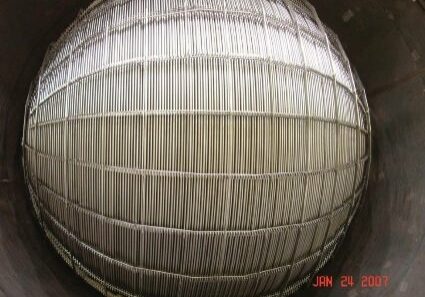
| [Photograph of top-down view of steam generator tubes in a typical pressurized water reactor like Palisades.]
NEWS FROM BEYOND NUCLEAR Contact: Kevin Kamps, radioactive waste specialist, Beyond Nuclear, Kalamazoo, MI, (240) 462-3216, [email protected] Michael Keegan, chair, Don’t Waste Michigan, Monroe, MI, [email protected], (734) 770-1441 Terry Lodge, attorney, Toledo, OH, [email protected] Wallace Taylor, attorney, Cedar Rapids, IA, [email protected] (Interviews with nuclear engineer Arnie Gundersen can be arranged through Kevin Kamps or Michael Keegan.)
|
Nuclear Engineer Warns NRC Safety Analyses Dangerously Biased |
Arnold Gundersen Compares Space Shuttle Disaster 40 Years Ago Today to Holtec’s Palisades Reactor Restart Risks
|
| COVERT TOWNSHIP, MICHIGAN and ROCKVILLE, MARYLAND, JANUARY 28, 2026–A nuclear engineer with 55 years of experience has again criticized the U.S. Nuclear Regulatory Commission’s (NRC) Advisory Committee on Reactor Safeguards (ACRS), for dangerous “survivor bias” and the Rockville, Maryland-based agency’s false confidence in the supposed safety of Holtec restarting the closed Palisades atomic reactor located on southwest Michigan’s Lake Michigan shore. The ACRS “advise[s] the Commission with regard to the hazards of proposed or existing reactor facilities and the adequacy of proposed safety standards.” Gundersen has pointed to the Space Shuttle Challenger disaster 40 years ago today as a cautionary tale regarding Holtec’s impending Palisades restart.
Arnold Gundersen serves as an expert witness for an environmental coalition (Beyond Nuclear, Don’t Waste Michigan, Michigan Safe Energy Future, et al.) opposing Holtec’s unprecedented scheme. Holtec International has indicated it could restart Palisades in February or March, 2026. The company missed its self-imposed, years-long announced deadline to restart the reactor by the end of 2025. (see: <https://beyondnuclear.org/ On January 27, 2026, Gundersen sent the following email message to staff at NRC’s ACRS: “January 28 is the 40th anniversary of the Space Shuttle Challenger Disaster. I have already suggested the historical analogy between that event and Palisades to the ACRS, to no avail [see: <https://beyondnuclear.org/wp-
But there is another logical trap that I believe the ACRS has fallen into. Engineers call this mistake “Survivor Bias”. The literature on Survivor Bias is extensive and I have no intention of citing all the references here. This is a short explanation that I lifted from Google:
My fear is that the NRC and ACRS have fallen into this logical trap on Palisades.
There are hundreds of examples of steam generators (SGs) being inspected and dozens of examples of steam generators being repaired successfully.
But Palisades does not match that cohort of those successes:
The confluence of these five factors implies that comparing Palisades to the fleet historical record is a fool’s errand.
I have absolutely no faith that this email will change the NRC’s position on the startup of Holtec’s Palisades plant but I needed to go on the record anyway.
Arnie Gundersen
Expert Witness for Beyond Nuclear, Don’t Waste Michigan, et al.”
“In January 1986, two NASA contract engineers identified that the Challenger Space Shuttle was endangered if it were to be launched in cold weather. Those engineers used all the professional channels available to prevent the launch. But the bureaucratic inertia within NASA to maintain the launch schedule caused those NASA engineers to be overruled. We all know the outcome of that safety lapse. I write to you today in the spirit of those two NASA engineers as I continue to express my safety concerns to the members of the ACRS. You provide the last possible public safety oversight before resurrecting the Palisades nuclear plant.” Gundersen continued: “Never in my 54 year professional career have I been more concerned about the integrity of the reactor coolant pressure boundary than I am about the condition of Palisades.” Gundersen warned the ACRS that “[i]t is not clear that the steam generator (SG) tubes or the SG tube sheet will survive for even half a year after Palisades’ ‘resurrection’ — Holtec’s word choice — is complete.” In June, 2025, Gundersen warned the ASLB (NRC’s Atomic Safety and Licensing Board) that the likely burst of a single steam generator tube would release a certain amount of hazardous ionizing radioactivity into the Lake Michigan shoreline environment, but a cascading failure of enough steam generator tubes could lead to a full-blown reactor core meltdown, releasing a catastrophic amount of hazardous radioactivity into the environment. Gundersen had previously warned in 2015 how catastrophic that could be for the Great Lakes, in an essay entitled “Downstream,” focused on yet another pathway to meltdown at Palisades — the worst neutron-embrittled reactor pressure vessel in the country, according to NRC, at risk of pressurized thermal shock through-wall fracture. (See point number four, on page 5 of 15 on the PDF counter, in this April 2013 NRC document. Tied for worst-embrittled is Point Beach Unit 2 in Wisconsin, with Lake Michigan, direct source of drinking water for 16 million people in four states, wedged between.) Gundersen has also pointed out that, while unlikely, SG tube damage can happen during hot functional testing, even before the nuclear fission reaction is actually restarted. In a presentation to the Michigan Public Service Commission (MPSC) in spring 2006 (see Page 2), Palisades’ original owner, Consumers Energy, cited the reactor pressure vessel embrittlement as a top reason for selling the nuclear plant to Entergy. On the very same page, Consumers also cited the need for steam generator replacement, two decades ago. But the steam generators have never been replaced, because NRC has not required it. Although Holtec gave lip service to replacing the steam generators, at a cost of $510 million, in a secret document sent to the U.S. Department of Energy (see: <https://beyondnuclear.org/ The Associated Press has cited NRC’s weakening of its reactor pressure vessel embrittlement/pressurized thermal shock safety regulations as a top example of the agency’s regulatory retreat. (see: <https://www.ap.org/media- A second nuclear engineer with more than 40 years of experience has submitted additional warnings to ACRS regarding Palisades’ steam generators. (see: <https://beyondnuclear.org/ For more information, see Beyond Nuclear’s “Newest Nuke Nightmares at Palisades, 2022 to Present”. It is a one-stop-shop of web posts dating back to April 2022, when Holtec CEO Krishna Singh first floated “Small Modular Reactor” construction and operation at Palisades, and Michigan Governor Gretchen Whitmer first floated restarting the closed-for-good reactor. These schemes replaced the promise to decommission Palisades, which Entergy had made in 2016, and which Holtec had made since late 2020, the bait and switch trick, big lie, and con job which enabled Holtec to acquire Palisades in the first place. ### |
| Beyond Nuclear is a 501(c)(3) nonprofit membership organization. Beyond Nuclear aims to educate and activate the public about the connections between nuclear power and nuclear weapons and the need to abolish both to safeguard our future. Beyond Nuclear advocates for an energy future that is sustainable, benign and democratic. The Beyond Nuclear team works with diverse partners and allies to provide the public, government officials, and the media with the critical information necessary to move humanity toward a world beyond nuclear. Beyond Nuclear: 7304 Carroll Avenue, #182, Takoma Park, MD 20912. [email protected]. www.beyondnuclear.org. |
Support Beyond Nuclear
Help to ensure a safer, greener and more just world for all