“Make Atoms Great Again?”
Trump is melding a financial partnership between the fed and the US nuclear industry
President Trump has set a course to “Make Atoms Great Again” as part of his White House “call to action” that is not only extremely risky but a foolhardy national energy policy shift that raises potential ethical questions.
In October 2025, news outlets reported on President Trump’s plan to finance a government attempt to kickstart an $80 billion expansion of Westinghouse Electric’s US domestic AP1000 nuclear power fleet. Westinghouse Electric is under new Canadian ownership (Brookfield Asset Management/Brookfield Renewable Partners (NYSE) and Cameco (NYSE). The Canadian companies acquired Westinghouse from the then Japanese parent company, Toshiba, amid the ruins of the US “nuclear renaissance” first bankruptcy.
Despite Congressional backing with a host of legislated incentives including lucrative production and financial tax credits as well as streamlined federal licensing process through the Energy Policy Act of 2005, the nuclear revival effort ultimately crash landed in South Carolina and Georgia with Westinghouse’s 2017 financial collapse due to uncontrollable reactor construction cost overruns and the industry’s decades old gross failure to manage scheduled times to completion. This was the so called “nuclear renaissance” first real litmus test on its economic viability. The nation’s entire nuclear industry stood around to watch the economic mayhem unfold. Of the nuclear industry’s 34+ units that pursued the federal licensing process most cancelled their applications or filed away their federal construction licensing approvals from the Nuclear Regulatory Commission not daring to follow through.
Only four Westinghouse AP1000 reactor units in the entire US mustered the financing to break ground and proceed with construction. The V.C. Summer Units 2 & 3 (SC) were abandoned mid-construction with nearly $10 billion in sunk cost still borne on the backs of captured ratepayers as the advance the financers though their utility bills without a watt of benefit. They and their South Carolina Public Utility Commissioners were bamboozled in a massive corporate fraud led by SCANA senior utility executives and a Westinghouse Vice President who pled guilty in federal court and punished with prison sentences. Only the Vogtle Units 3 & 4 (GA) were completed to begin operations: seven years behind schedule at a staggering cost in excess of $35 billion instead of the utility projected $14 billion price tag.
The Trump Administration has now picked Westinghouse and the same AP1000 “advanced” reactor design as its “national champion” to receive a minimum $80 billion in federal taxpayer money. Only now, the President looks to convert the US Department of Energy’s (DOE) loan and grant programs into equity stakes in the project where the government gets a 20% ownership stake in Westinghouse’s subsequent profits.
The Trump White House has already merged government equity ownership into at least five other private & publicly owned companies including: a 10% stake in the profits from Intel Corp. (INTC) and its previously awarded CHIPS Act grants as an investment in common stock; the Department of Defense (DOD) is a government shareholder with a 15% stake in the rare earth supplier, MP Materials (MP); the DOE is taking a 5% equity stake in Lithium Americas (LAC) and a 5% stake in its joint venture with General Motors, as part of a loan restructuring deal for a lithium mine project; the DOD has acquired a 10% stake in Trilogy Metals (TMQ) plus warrants to purchase an additional 7.5%, as part of an investment to develop critical mineral projects in Alaska, and; the US government has negotiated a “golden share” in US Steel delisted to a private corporation as part of the approval for its acquisition by Japan’s Nippon Steel. The US government’s share is non-financial but President Trump won significant veto control over strategic decisions in the corporate merger agreement with Japan, such as plant closures or job reductions.
Still more corporations are in negotiation to receive federal equity shares with the Trump Administration.
Of more concern in the case of government acquiring equity in nuclear power development, on November 9, 2025, U.S. DOE Secretary Chris Wright (a former a fossil fuel extraction CEO and just prior to his US Senate confirmation a prominent board member of a nuclear power startup company) went before the American Nuclear Society’s 2025 Annual Winter Conference to assure the industry that most of the hundreds of billions of dollars in the nation’s federal energy loan program money will go to resuscitate a seriously aging nuclear power industry.
Without providing figures and short on details, the DOE is apparently preparing to sink much of its federal energy loans and grants dollars, into additional US government equity shares in a second “nuclear renaissance” for anticipated future profits.
Given the still sketchy details and the amount of US taxpayer dollars at stake in the Trump deal, this plan appears to raise ethical questions.
Foremost, does the emergence of the fed gambling with taxpayer dollars for government equity shares in a financially shaky nuclear industry admittedly seeking to quadruple its expansion introduce a serious conflict of interest for the independent federal regulatory oversight and licensing process already under attack by the Trump Administration?
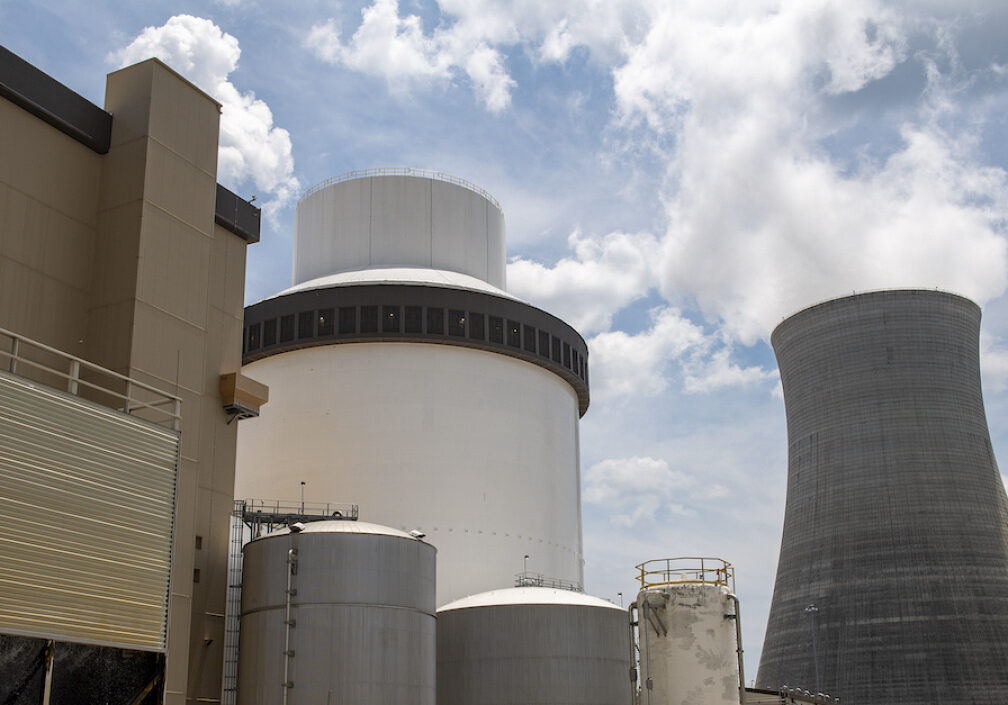
[Photo credit: US Department of Energy, Westinghouse AP1000, Vogtle Unit 3]
Support Beyond Nuclear
Help to ensure a safer, greener and more just world for all